
🏠 Trusted Local Roofers
EPDM Rubber Roofing in Hinckley
Flat roofs on garages, extensions and dormers take more punishment than any pitched roof above them, and the covering you choose decides whether that section stays dry for ten years or thirty. EPDM rubber roofing in Hinckley has become the go-to choice for homeowners who want a seamless, low-maintenance covering that shrugs off the weather rolling along the old Watling Street corridor. Tate & Sons Roofing fits EPDM rubber roofs across Hinckley, Burbage and the wider borough, working as a full roofing contractor across Hinckley, not just a single-product installer.
This page walks you through when EPDM beats felt or GRP fibreglass, what installation day actually looks like, real cost ranges, and how to keep a rubber roof watertight for decades. Start with a free drone survey and a written quote before anything is agreed — no scaffold needed just to take a look, and no charge either way.
- Fully Insured
- 10-Year Guarantee
- 5-Star Rated
Quick Free Estimate - No Obligation
We're not just roofers – we're your neighbours.
Fully Insured • Response within 15 mins
🔒 Your details are safe with us. No spam, ever.
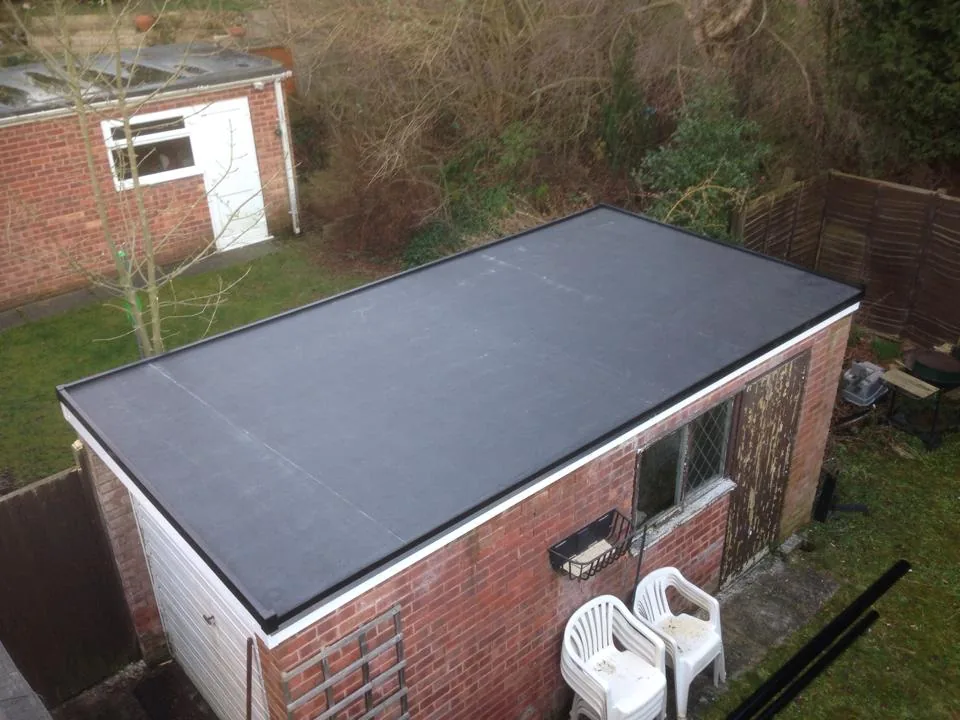
Spot the Signs Your Flat Roof Needs EPDM Rubber Roofing
Old felt roofs give clear warning before they fail outright. Bubbles, cracked seams and dark patches that stay damp long after rain has stopped are the usual first signs. By the time water is showing on a garage ceiling or extension wall, the old covering has often been letting water through for months.
Look out for these on any flat-roofed garage, extension or dormer around Hinckley:
- Bubbling, blistering or cracked patches across the felt or old covering
- Seams that have lifted or split, especially at the edges and upstands
- Standing water that sits for more than 48 hours after rain
- Moss or algae building up in low spots where water collects
- Damp patches or staining on the ceiling directly below
- A covering more than 15 to 20 years old showing repeated small repairs
A flat roof covering rarely fails all at once. It fails one weak seam at a time, until patching costs more than it saves. Once a felt or older covering reaches that point, an EPDM rubber roof is usually the better long-term answer, and it is a job that sits alongside our wider flat roofing work across Hinckley and Burbage. A free drone survey shows exactly where the weak points are, with footage rather than guesswork.
EPDM vs GRP vs Felt — Choosing the Right Flat Roof Covering
Three coverings account for almost every flat roof fitted around Hinckley. EPDM rubber is a single-ply synthetic rubber membrane, usually laid as one continuous sheet with no joins across a garage or small extension roof. That single-sheet fit is what gives it the edge over felt, which is built from overlapping layers with seams that are the most common place a roof starts to leak.
| :-: | :-: | :-: | :-: |
| Covering | Typical cost (per m²) | Typical lifespan | Best for |
| EPDM rubber | £70–£110 | 30–50 years | Garages, extensions, dormers wanting a seamless, low-maintenance finish |
| GRP fibreglass | £80–£130 | 25–30 years | Balconies, roof terraces and roofs with regular foot traffic |
| Felt (torch-on/high-performance) | £40–£70 | 15–20 years | Tighter budgets and shorter-term projects |
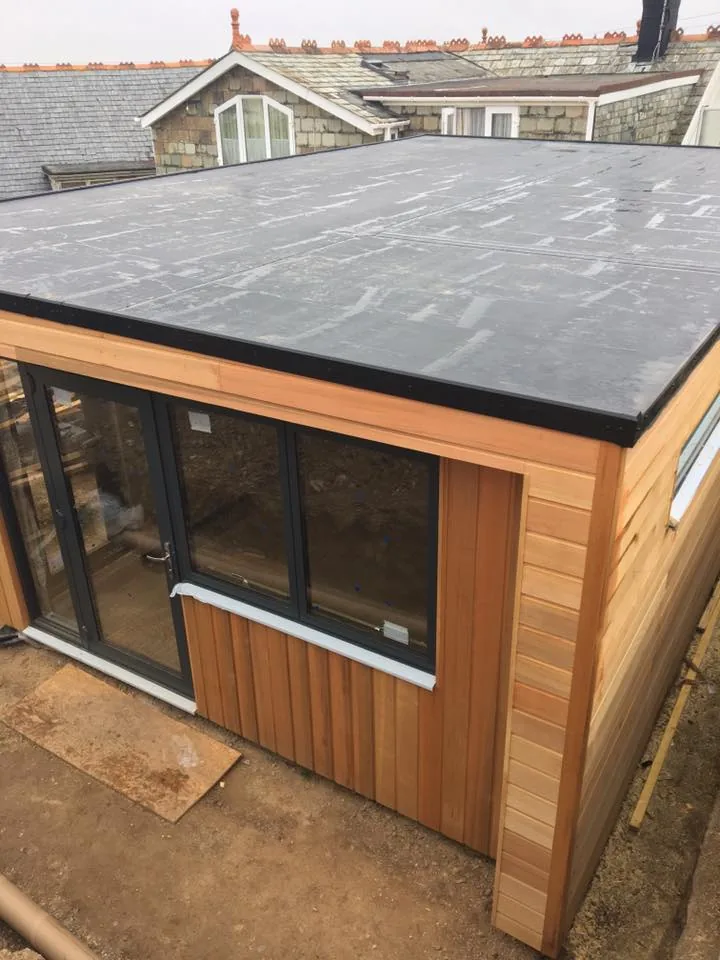
GRP fibreglass sets hard as a rigid, fully bonded surface and handles regular foot traffic better than rubber, which makes it the stronger pick for a roof terrace or balcony people walk on often. Felt still has its place on tighter budgets or short-term projects, but it generally needs replacing sooner and shows its age faster than either alternative. In short: EPDM suits garages, extensions and dormers where a seamless, long-life, low-maintenance finish matters most; GRP suits roofs that double as usable outdoor space; felt suits jobs where upfront cost is the main driver.
Where a job needs the rigid, walk-on strength of fibreglass instead, our GRP fibreglass roofing service covers that separately. Daniel Whitmore, our project manager, fits full re-roofs across the area and specialises in leadwork and heritage detailing, but his remit covers modern flat systems too — he will tell you honestly which covering suits your garage or extension, not just sell you the one on offer that week. Homes around Burbage and the newer builds near Earl Shilton and Barwell often mix pitched fronts with flat rear extensions, and getting the flat section right matters just as much as the tiles on show from the street.
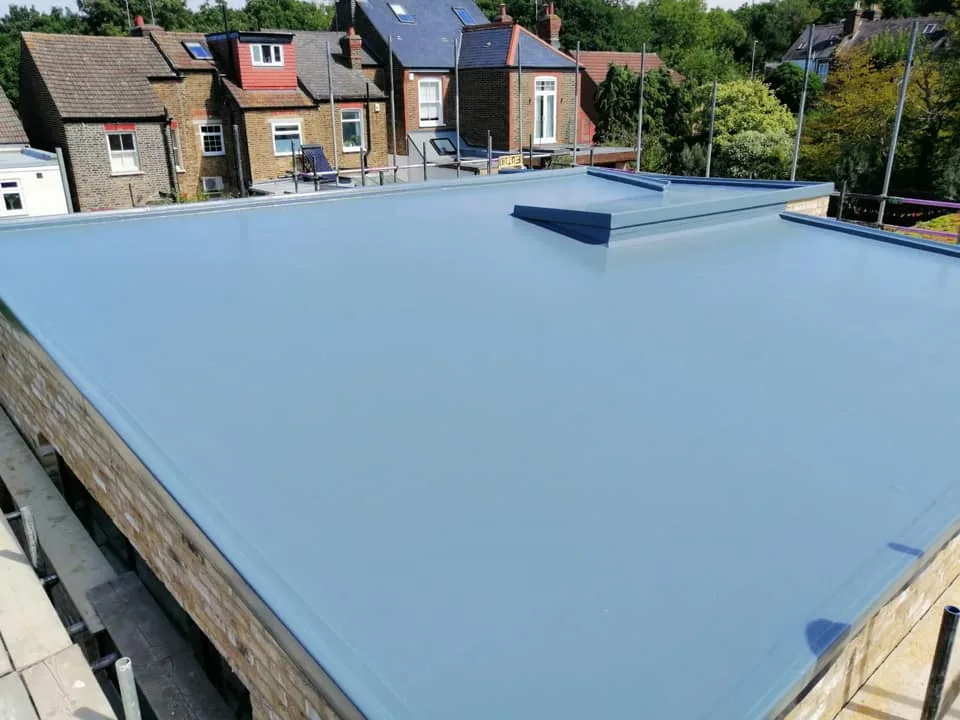
What to Check Before Installation Day
Most straightforward flat roof recoverings, including a like-for-like EPDM replacement, do not need planning permission. Permission is more likely if the roof is being raised, a new dormer is being added, or the property is listed or sits within a conservation area. Building Regulations still apply in most cases, covering weather resistance, insulation and structural strength, and we handle the Building Control sign-off as a standard part of every job.
Before quoting, we check whether the old covering can stay in place under a new deck layer or whether it needs stripping back completely. A soft or spongy deck, found on many older garages, always needs replacing first, whatever covering goes on top of it.
The rapidly growing new-build estates around Sketchley Hill and out toward Sapcote and Stoney Stanton are seeing a steady stream of flat-roofed garden rooms, garages and rear extensions, and EPDM has become the expected covering on most of them. Properties further out along the A5 and near the M69, where wind-driven rain hits harder with less shelter, need the deck properly checked for movement before any membrane goes down, since a sound base is what makes an EPDM roof last its full lifespan.
How We Fit Your EPDM Rubber Roof, Start to Finish
An EPDM installation follows the same order on every job:
- Old covering stripped back and the deck exposed
- Timber deck checked, with any soft or rotten sections replaced
- Insulation added or upgraded where the specification calls for it
- Edge trims and drip details fixed around the perimeter
- The rubber sheet unrolled and left to relax before fitting
- The membrane bonded fully with adhesive, working out any creases
- Edges dressed into trims, upstands and outlets, then checked for a full bond
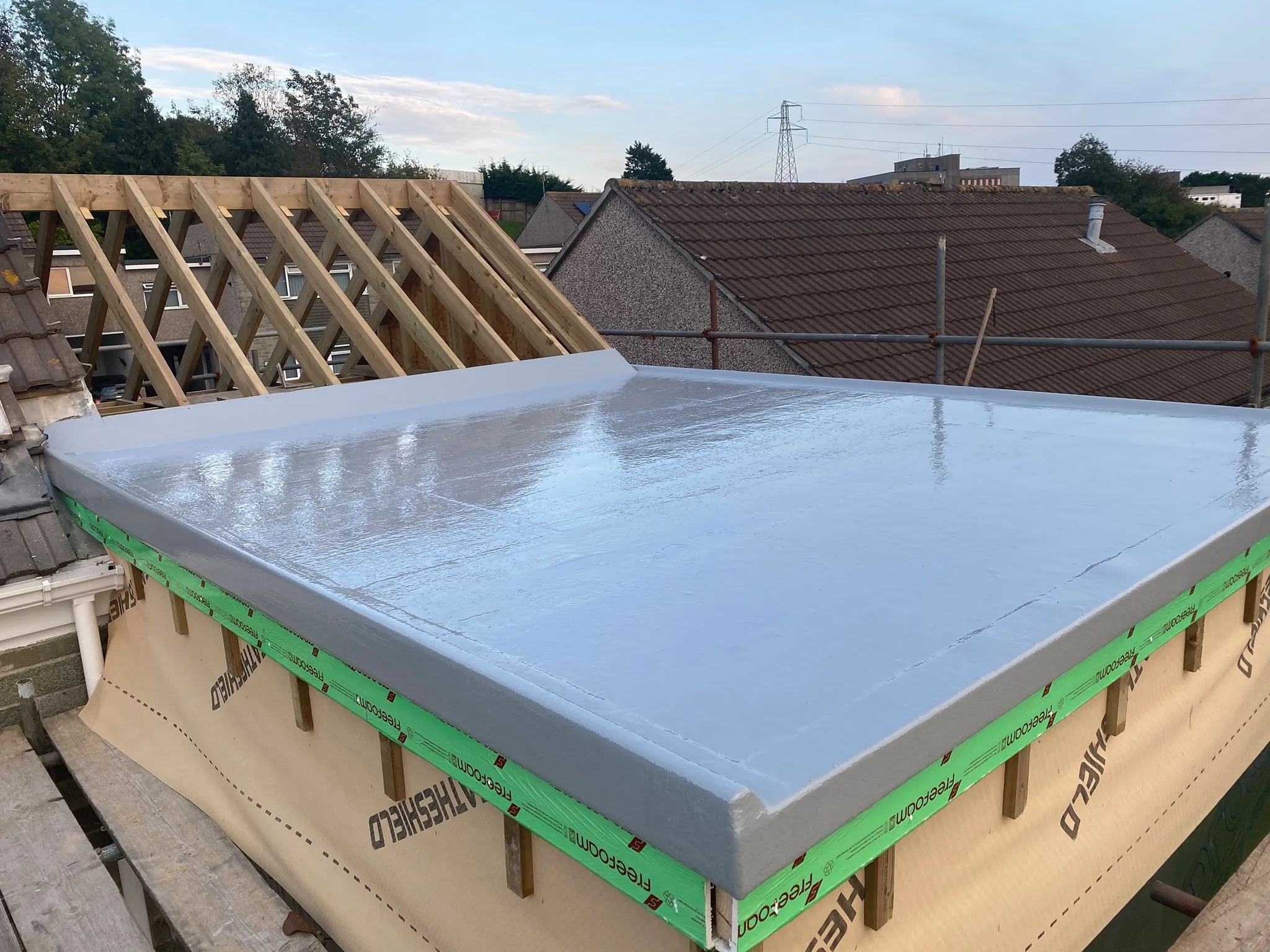
A single garage roof under 20m² is usually finished in a single day. A larger extension or dormer roof typically takes 2 to 3 days, depending on deck condition and access. Because the membrane goes down as one continuous sheet rather than overlapping strips, there is far less that can go wrong at the seams compared with a felt roof, and the finished surface is ready to shed water the moment the adhesive has cured.
What EPDM Rubber Roofing Really Costs in Hinckley
As a general guide, EPDM rubber roofing costs £70–£110 per m² fully fitted, covering the membrane, adhesive, edge trims and disposal of the old roof. A single garage roof around 15m² typically comes to £1,000–£1,600. A double garage, larger dormer or small extension roof usually runs £2,500–£4,000, depending on size and deck condition.
What pushes a price up or down:
These are general market ranges, not a quote for your roof. Two garages the same size can price differently once deck condition and access are factored in. A fixed price needs a survey.
- **Deck condition*— a rotten or spongy deck needs replacing before the membrane goes on, typically adding £300–£800
- **Insulation upgrade*— bringing a warm roof build-up up to current standards typically adds £15–£30 per m²
- **Access*— a garage roof reached easily from ground level costs less than one boxed in behind a house
- **Roof size and shape*— larger, simpler rectangles cost less per m² than small, awkward roofs with lots of upstands
- **Strip-out and disposal*— removing old felt or GRP and taking it to licensed disposal usually adds £150–£400
Keep Your EPDM Roof Watertight for Decades
EPDM rubber is one of the lowest-maintenance coverings you can fit, but a little attention keeps it performing for its full lifespan. Modern membranes, fully bonded to the deck during installation, are far less prone to the shrink-back that gave older rubber roofs a poor reputation decades ago. Properly fitted and left undisturbed, EPDM resists UV damage and does not crack the way ageing felt does.
A simple seasonal routine covers most of what an EPDM roof needs:
- Clear leaves and debris from outlets and gutters each autumn
- Check for standing water more than 48 hours after heavy rain
- Look over flashings and upstands around chimneys and walls once a year
- Book a free drone survey every few years, or after any major storm
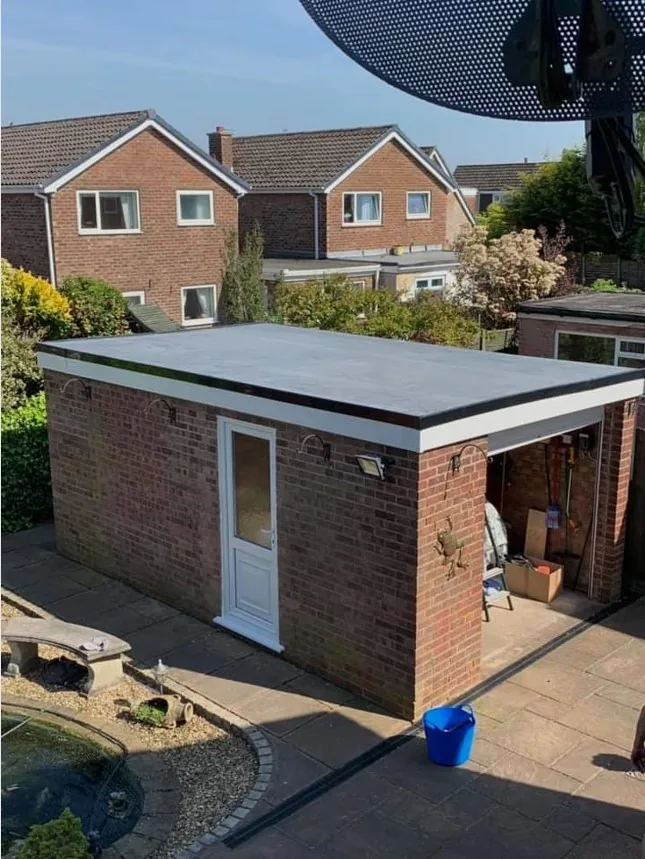
Ponding water is the main thing to watch. A flat roof needs a slight fall, usually a minimum of 1:80 and ideally 1:40, so rainwater runs off rather than sitting for days. Roofs near Hollycroft Park and the newer developments around Sketchley Brook, where gutters and outlets can fill quickly with leaf litter from nearby planting, need those outlets checked more often than a roof in an open, exposed spot. For technical background on how flat roof insulation and waterproofing layers are typically built up, the Liquid Roofing and Waterproofing Association's guidance on inverted roof systems is a useful reference, and it is a build-up option worth discussing where an EPDM roof also needs to carry insulation above the membrane.
Small tears or lifted edges are usually a straightforward repair with a detail kit and primer, rather than a reason to replace the whole roof. Catching a small problem early always costs less than letting it run.
Why Hinckley Homeowners Choose Tate & Sons for EPDM Roofing
You are not just buying a rubber sheet — you are buying whoever bonds it down. Daniel Whitmore, our project manager, runs full re-roofs across the area and specialises in leadwork and heritage tile and slate detailing, and that same attention to detail carries over into every modern flat system he fits, EPDM included. He is part of the crew that turns up on the day, not just the name on the quote.
Founder James Tate started out on the tools more than 20 years ago and still quotes the majority of jobs personally, so the person weighing up your garage or extension roof is the one standing behind the finished work. Between us we bring 40 years of combined team experience, hold NVQ Level 2 and 3 qualifications in Roofing, and carry CSCS cards. Sophie Bennett, our office manager, keeps quotes, scheduling and aftercare running smoothly from the first call through to the finished job. Read more about the people behind the work on our About Tate & Sons Roofing page.
Areas We Serve Across Hinckley and Bosworth Country
We fit EPDM rubber roofs across Hinckley and the surrounding borough. If your area is not on the list below, call us anyway — there is a strong chance we already cover you.
- Hinckley (LE10)
- Burbage (LE10)
- Barwell (LE9)
- Earl Shilton (LE9)
- Sapcote (LE9)
- Sharnford (LE10)
- Wolvey (LE10)
- Higham on the Hill (CV13)
- Sutton Cheney (CV13)
- Stoke Golding (CV13)
- Market Bosworth (CV13)
- Nuneaton (CV10 / CV11)
- Bedworth (CV12)
Got Questions?
Your EPDM Rubber Roofing Questions, Answered Properly
How much does EPDM rubber roofing cost in Hinckley?
As a general guide, EPDM rubber roofing costs £70–£110 per m² fully fitted, with a single garage roof around 15m² typically coming to £1,000–£1,600. A double garage, dormer or small extension roof usually runs £2,500–£4,000. Deck condition, access and insulation upgrades all affect the final figure. A free drone survey gives you an exact written price rather than a rough estimate over the phone.
How long does an EPDM rubber roof actually last?
A properly fitted EPDM rubber roof typically lasts 30 to 50 years, well beyond most felt roofs and ahead of GRP fibreglass on a straight lifespan comparison. Manufacturer warranties on the membrane itself commonly run 20 to 25 years. We back every installation with our own 10-year workmanship guarantee on top of that, covering how the roof was fitted, not just the material.
Is EPDM better than felt or GRP fibreglass for a flat roof?
It depends on how the roof gets used. EPDM generally lasts longer than felt and costs less than GRP, and its single-sheet fit removes the seams that cause most felt roofs to leak. GRP is the stronger choice where a roof doubles as a terrace or balcony people walk on regularly, while felt suits tighter budgets on shorter-term projects. The comparison table above sets out the real cost and lifespan differences side by side.
Can you walk on an EPDM rubber roof?
Yes, but only with care, and walkway pads are recommended for regular access. The membrane can be more vulnerable to damage from sharp objects or concentrated weight during very hot or very cold weather. For a roof that needs frequent foot traffic, GRP fibreglass is usually the better-suited covering from the outset.
Does EPDM rubber roofing need much maintenance, and can it be repaired?
EPDM needs very little routine maintenance beyond keeping outlets and gutters clear. Small tears, lifted seams or damage from a fallen branch are usually repaired with a purpose-made detail kit and primer rather than a full roof replacement. Most problems that do arise trace back to installation quality or ageing, not the membrane itself, which is why fitting it right the first time matters.
Can solar panels be fitted on an EPDM rubber roof?
Yes, but the mounting method matters. Ballasted or standoff mounting systems that do not puncture the membrane are the usual choice on EPDM, keeping the waterproof layer intact. Any penetration through the membrane needs to be specified and sealed correctly at installation, so it is worth discussing solar plans before the roof goes down rather than after.
Can EPDM be laid over old felt, or does the deck need stripping back?
In most cases the deck needs stripping back to sound timber before EPDM goes down, since the membrane needs a smooth, dry, stable base to bond to properly. A soft or damp deck under old felt is common on older garages and will undermine even a well-fitted membrane above it. We check the deck during the free survey, so you know before work starts whether a full strip-back is needed.
Is EPDM a good fit for the new flat-roofed extensions going up around Sketchley Hill and Sapcote?
Yes, and it has become the standard covering on most of them. The garden rooms, garages and rear extensions appearing across these growing new-build areas are almost always specified with a flat roof, and EPDM's seamless, long-life finish suits that modern build style well. It also tends to match the clean lines of newer joinery and render better than a felt or older GRP finish would.
Does exposure along the A5 or near the M69 change how an EPDM roof is detailed?
It can. Properties along the old Watling Street corridor and out toward Higham on the Hill take a harder battering from wind-driven rain, with less shelter to slow it down than a street in the town centre. Edge trims, drip details and adhesive coverage at upstands often need extra attention on these more exposed roofs to hold up long-term. We factor a property's position and exposure into the specification, not just its size.
Book Your Free EPDM Roof Survey Today
See exactly what your flat roof needs before any work starts. No ladders, no pressure — just a clear picture from a local Hinckley team.
Every season a failing felt or ageing rubber roof is left alone, water works further into the deck beneath it, and a straightforward recover turns into a bigger timber repair. A quick, free drone survey today tells you exactly where you stand, and the right answer is often smaller and more affordable than you feared. Book now, get an honest quote, and get your flat roof sorted properly — first time.
Call the Hinckley team today on 01455 242595, or request your free drone survey online. We're already working across your area.
Book Your Free Drone Roof Survey
See exactly where your roof stands, with no obligation and no pressure. Call our Hinckley team or request your free drone survey today.
Get in Touch
Tate & Sons Roofing — Hinckley Office
10 Brosdale Drive, Hinckley, LE10 0SW
📞 01455 242595
✉️ [email protected]